

Whitefield’s Epitaph
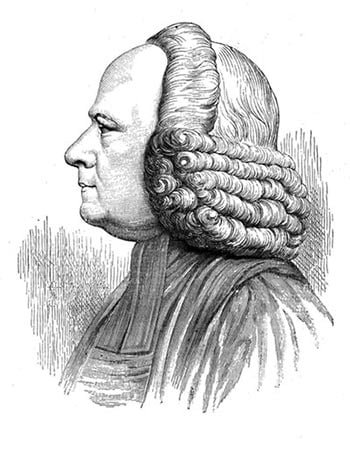
George Whitefield
Whitefield’s Epitaph. All that was mortal of this great evangelist now rests in peace under the pulpit of the “Old South” Presbyterian Church, Newburyport, Mass., and was there placed at his request. In one corner of the building is erected a handsome tablet of Italian marble to his memory, bearing upon its face the following inscription:
“This cenotaph is erected, with affectionate veneration to the Rev. George Whitefield, born at Gloucester, England, December 16, 1714. Educated at Oxford University; ordained 1736. In a ministry of thirty-four years, he crossed the Atlantic thirteen times, and preached more than eighteen thousand sermons.
As a soldier of the cross, humble, devout, ardent, he put on the whole armor of God; preferring the honor of Christ to his own interest, repose, reputation and life. As a Christian orator, his deep piety, disinterested zeal and vivid imagination gave unexampled energy to his look, utterance and action.
Bold, fervent, pungent and popular in his eloquence, no other uninspired man ever preached to so large assemblies, or enforced the simple truths of the Gospel by motives so persuasive and awful, and with an influence so powerful on the hearts of his hearers. He died of asthma September 30, 1770, suddenly exchanging his life of unparalleled labors for his eternal rest.”
Whitefield’s Epitaph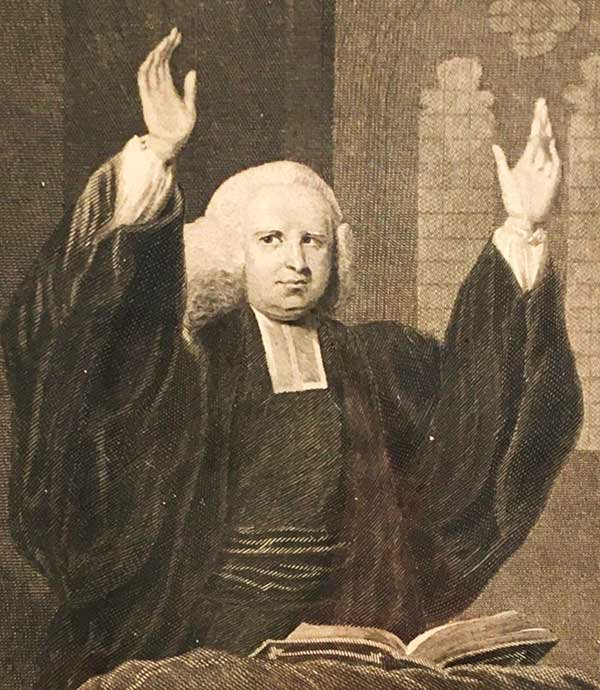
George Whitefield preaching
George Whitefield preaching
Below is a polished, formal memorial-style description of George Whitefield, crafted to follow naturally after the inscription you shared. It’s designed to read as though it belongs in a historical publication, a commemorative booklet, or a church memorial context.
George Whitefield’s legacy endures as one of the most remarkable testimonies to evangelical zeal in the history of the English-speaking world. Though his mortal remains now rest beneath the pulpit of the Old South Presbyterian Church in Newburyport, the influence of his life continues to echo far beyond the quiet sanctuary that holds his tomb.
His story is not merely that of a gifted preacher, but of a man wholly given to the service of God, whose voice and example helped shape the spiritual character of a generation.
Born in Gloucester, England, in 1714, Whitefield rose from humble origins to become a central figure in the transatlantic revival known as the Great Awakening. His years at Oxford awakened in him a deep sense of spiritual seriousness, and his early association with the Methodist movement helped form the disciplined piety that would mark his ministry.
Yet it was his extraordinary preaching gift—recognized almost immediately after his ordination in 1736—that propelled him into a role unlike any other in his age.
Whitefield’s ministry was defined by movement. Refusing to be confined by parish boundaries or ecclesiastical expectations, he carried the Gospel wherever he believed it was needed most. In an era when travel was slow and dangerous, he crossed the Atlantic thirteen times, traversing Britain and the American colonies with a tirelessness that astonished even his contemporaries.
Over the course of thirty-four years, he preached more than eighteen thousand sermons, often addressing crowds so large that no church could contain them. Fields, town squares, and open hillsides became his sanctuaries, and multitudes gathered—sometimes tens of thousands at once—to hear him proclaim the message of salvation.
What distinguished Whitefield was not merely the frequency of his preaching, but the fervor with which he delivered it. His voice, capable of carrying immense distances, was matched by a dramatic expressiveness that made his sermons unforgettable.
Yet beneath the oratorical brilliance lay a profound humility. He consistently deflected praise, insisting that he was but a servant of Christ, and that any good accomplished through him belonged to God alone. His life bore the marks of this conviction: a willingness to endure hardship, misunderstanding, and physical exhaustion for the sake of the Gospel he loved.
Whitefield’s influence transcended denominational boundaries. He worked alongside Anglicans, Presbyterians, Congregationalists, and Methodists, urging believers to focus on the essentials of faith rather than the divisions that so often fractured the church.
His ecumenical spirit helped foster a broader evangelical identity, one that would shape both British and American Christianity for generations to come. In the American colonies especially, his preaching contributed to a renewed sense of spiritual vitality, encouraging personal devotion, moral seriousness, and a recognition of the need for heartfelt religion.
His final days were in keeping with the rest of his life. Even as asthma weakened his body, he continued to preach with undiminished passion, delivering his last sermon on the eve of his death in 1770. He passed from labor to rest suddenly, leaving behind a ministry unparalleled in scope and impact.
Today, the marble cenotaph in Newburyport stands as a quiet witness to a life spent in extraordinary service. Yet the truest memorial to George Whitefield is found not in stone, but in the countless lives awakened, encouraged, and transformed through his preaching. His voice may be silent, but the spiritual fire he helped kindle continues to burn.
For further research:
George Whitefield Wikipedia
George Whitefield Britannica