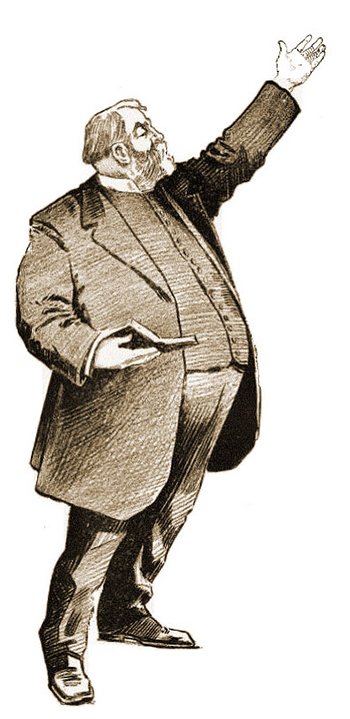



Dwight. L. Moody
1872 London Revival
Dwight. L. Moody
The 1872 London Revival, a profound spiritual awakening that surged through the heart of the British Empire, stands as a landmark event of the 19th century. This movement was not a sudden, inexplicable phenomenon but the culmination of complex social, religious, and cultural currents, catalyzed into a roaring flame by the unlikely figure of an American evangelist, Dwight L. Moody.
Characterized by fervent, organized prayer, passionate and direct preaching, and an unwavering focus on personal conversion, the revival left an indelible mark on the religious and social landscape of London, with shockwaves that reached across Britain and the wider world.
This report delves into the intricate history of this revival, exploring its antecedents in the complex spiritual climate of Victorian London, the pivotal figures who shaped its course, the innovative methods that defined its character, and the lasting consequences of its powerful surge.
The Religious and Social Climate in Pre-Revival London
To comprehend the sheer impact of the 1872 revival, one must first understand the ground in which its seeds were sown. The London of the early 1870s was a city of stark contradictions.
It was the epicenter of a global empire, a hub of industrial might, financial power, and intellectual ferment. Yet, beneath this veneer of progress and prosperity lay deep-seated social anxieties and a complex, often conflicted, religious landscape.
On one hand, a palpable sense of spiritual malaise and institutional decline permeated many sectors of society. Within the established Church of England, formalism and ritualism often overshadowed personal piety.
The class divide was starkly reflected in the pews; the urban working classes, swelling in number due to the Industrial Revolution, were largely alienated from the institutional church, which they often viewed as an extension of the upper-class establishment. An increasing number of individuals began to question traditional Christian doctrines, spurred by the intellectual currents of the day.
Charles Darwin's On the Origin of Species (1859) and The Descent of Man (1871) had fundamentally challenged biblical accounts of creation, providing a powerful scientific framework for a world without divine intervention. From Germany, the methodologies of "higher criticism" subjected the Bible to historical and literary analysis, questioning its divine inspiration and inerrancy.
This intellectual pincer movement contributed to a perceived chasm between modern thought and traditional faith, with Christianity facing sharp criticism and even mockery from influential circles, leading many to embrace skepticism, agnosticism, or deism.
On the other hand, Victorian society was far from being entirely secular. This era witnessed a powerful surge in evangelical fervor, largely outside the formal structures of the state church. Movements like Methodism, born from the revivalist spirit of the previous century, continued to have a significant impact, particularly among the lower and middle classes.
A robust network of Christian organizations championed social reform, reflecting a deep-seated belief that faith must be demonstrated through action. The legacy of the Clapham Sect, a group of influential Anglican social reformers, continued to inspire efforts to abolish slavery, reform prisons, and promote education.
This evangelical spirit, coupled with a growing, horrified awareness of the city's social ills—the Dickensian poverty, the gin palaces, the rampant child labor, and the squalid living conditions in the slums—created a fertile ground for a message of hope and moral transformation.
There was a deep-seated yearning for a spiritual reality that could address both the intellectual doubts of the age and the profound social brokenness visible on every London street. It was into this complex tapestry of doubt and devotion, of spiritual apathy and fervent zeal, that D.L. Moody would step.
The Unlikely Evangelist: The Rise of Dwight L. Moody
Dwight Lyman Moody, born in Northfield, Massachusetts, in 1837, was a man seemingly ill-equipped to lead a spiritual awakening in the sophisticated heart of the British Empire. Lacking formal education and possessing a blunt, unpolished speaking style, he was the antithesis of the eloquent, classically-trained English clergyman.
His transformation from an ambitious shoe salesman to a world-renowned evangelist was a testament to his raw energy, organizational genius, and a profound personal experience of faith.
Moody's early life was defined by a relentless drive for material success. In 1854, he journeyed to Boston to work in his uncle's shoe business. It was there, in a Sunday school class led by a humble teacher named Edward Kimball, that Moody underwent a profound religious conversion that radically reoriented his life's ambitions.
This newfound faith ignited an unquenchable passion for evangelism. He moved to the burgeoning, rough-and-tumble city of Chicago, where he threw himself into Christian work with characteristic zeal. He started a Sunday school in a converted saloon, focusing on reaching the city's poor and often-neglected children.
His work with the YMCA and his tireless efforts during the American Civil War further honed his skills as a speaker and organizer. Moody's captivating personality, his use of simple, direct language, and his focus on practical, life-changing faith drew enormous crowds, establishing him as a compelling and unconventional evangelist in America.
A crucial element in Moody's ministry was his partnership with the musician and hymn-writer Ira D. Sankey. Moody understood, perhaps better than anyone before him, the power of music to prepare the heart for the spoken word.
Sankey's soulful singing and the simple, emotionally resonant gospel hymns he championed became the defining soundtrack of the revival meetings. The Moody-Sankey duo was a powerful combination: Moody appealed to the mind and the will with direct, logical appeals, while Sankey touched the heart and emotions through music.
The Spark That Ignited the Flame
The catalyst for Moody's transatlantic journey was born from personal and spiritual crisis. In 1871, the Great Chicago Fire devastated the city, destroying Moody's church, his home, and the YMCA building he had worked so hard to establish. This catastrophic loss, combined with a growing sense of his own spiritual inadequacy, propelled him to seek a deeper encounter with God's power.
He felt that despite his success in drawing crowds, he lacked the spiritual authority to bring about lasting transformation. While in New York, following the fervent prayers of two women from his congregation, Moody experienced a profound spiritual renewal, which he later described as a "baptism of the Holy Spirit" and a "baptism of power."
This transformative experience filled him with an overwhelming sense of God's love and an intensified desire to share the Gospel with renewed fervor and conviction.
Driven by this spiritual awakening, Moody, accompanied by Sankey, embarked on a journey to England in June 1873 (often retrospectively associated with the groundwork laid in 1872). The trip was initially intended for rest and a small amount of preaching, born from a somewhat casual invitation.
The men who had invited him, William Pennefather and Cuthbert Bainbridge, had both passed away by the time he arrived, leaving Moody and Sankey in London with no formal sponsors, no organized meetings, and very little money. It was an inauspicious beginning. However, through a series of providential connections, they began holding meetings in a few small chapels.
The response was immediate and overwhelming. Word of the plain-spoken American and his singing partner spread like wildfire. The small chapels quickly became insufficient, forcing a move to larger and larger venues, and igniting a city-wide revival that would last for nearly two years.
Churches, Halls, and the Revival's Stage
The 1872 London Revival was not confined to any single denomination or building; it was an ecumenical movement that spilled out from traditional church structures into the largest secular spaces the city had to offer.
Initially, Nonconformist churches played a vital role. The Metropolitan Tabernacle, pastored by the world-renowned Baptist preacher Charles Haddon Spurgeon, was already a center of immense spiritual activity.
Spurgeon, the "Prince of Preachers," was broadly supportive of Moody's work, recognizing in the American a shared passion for the Gospel. While distinct in style, their ministries were complementary, and Spurgeon's influence helped lend credibility to the burgeoning revival.
However, the revival's defining characteristic was its scale. The crowds soon outgrew even the largest churches.
Moody and his organizing committee made the innovative decision to rent massive public arenas. The Agricultural Hall in Islington, capable of holding over 20,000 people, became a primary venue. Later, a purpose-built structure, the 15,000-seat Hippodrome, was used. These mass meetings were a spectacle in themselves, drawing people from every social class.
The sight of thousands of Londoners—from aristocrats to shopkeepers to laborers—gathered together, singing hymns and listening intently to a former shoe salesman, was a powerful symbol of the revival's broad appeal.
The architectural trends of the era, such as the Gothic Revival seen in churches like St Mary Abbots, Kensington, reflected a desire for spiritual grandeur, but Moody’s approach demonstrated that the power of the revival was not in the architecture of the building, but in the message proclaimed within it.
Anatomy of a Movement: Key Features of the Revival
The 1872 London Revival was marked by several distinctive features that maximized its impact and became a template for modern mass evangelism:
- The Primacy of Prayer: Long before Moody and Sankey arrived, prayer was the engine of the movement. Small groups had been interceding for a spiritual awakening in London. During the campaigns, all-day and all-night prayer meetings were a common feature, creating an atmosphere of intense spiritual expectancy and dependence on God's intervention.
- Moody's Direct Preaching: Moody's preaching style was a revelation to many Londoners accustomed to dense, theological sermons. He used simple, Anglo-Saxon language, filled his messages with anecdotes and illustrations from everyday life, and spoke with raw emotion and sincerity.His sermons were structured around what he called the "Three R's": Ruin by sin, Redemption by Christ, and Regeneration by the Holy Spirit. His goal was not to win theological debates but to persuade individuals to make a personal decision for Christ, and he would conclude every sermon with a direct appeal for an immediate response.
- The Power of Music and Hymns: Ira D. Sankey's role cannot be overstated. Seated at a small, portable reed organ (a harmonium), he would sing gospel solos that captivated the massive audiences. The hymns themselves, many from his own collection of Sacred Songs and Solos, were theologically simple, emotionally direct, and musically memorable.Hymns like Charles Wesley’s "Love Divine, All Loves Excelling" fostered a sense of unity, while Sankey’s solos, like "There Were Ninety and Nine," often moved vast crowds to tears, breaking down emotional barriers and preparing the way for Moody's message.
- The Innovation of the "Inquiry Room": Perhaps Moody's most important organizational innovation was the "inquiry room." This was a space set aside where individuals who had responded to the appeal could go immediately after the meeting to receive personal counselling and prayer from trained volunteers.This practice provided immediate follow-up, helped prevent purely emotional decisions, and integrated new converts into a supportive community. It was a systematic approach to solidifying the results of mass evangelism.
- The Mobilization of the Laity: The revival was not a one-man show. It depended on the active participation of thousands of laypeople. Volunteers served as ushers, choir members, prayer partners, and counselors in the inquiry rooms.This emphasis on lay involvement broke down the clergy-laity divide, fostered a sense of shared ownership of the mission, and ensured the revival's impact was deeply embedded within the community.
Profound and Lasting Impact: The Legacy of 1872
The 1872 London Revival had a profound and multifaceted impact on London society and the wider Christian world, leaving a legacy that is still felt today.
- Conversions and Church Growth: The most immediate impact was the staggering number of conversions. While precise figures are impossible to ascertain, contemporary accounts suggest that tens, if not hundreds, of thousands of people made a profession of faith. Churches across the denominational spectrum—Anglican, Baptist, Methodist, Presbyterian—reported significant increases in attendance and membership.New congregations were planted, and existing ones were revitalized with a fresh sense of purpose.
- Spurring Social Reform: The revival ignited a renewed passion for social action. The Gospel message, as preached by Moody, emphasized that personal conversion should lead to a transformed life of service. The revival gave immense momentum to the Temperance movement, with thousands signing pledges to abstain from alcohol.It inspired the founding of numerous rescue missions, orphanages, and other charitable organizations aimed at alleviating the suffering of the urban poor. Many converts dedicated their lives to addressing social ills, viewing it as a direct outflow of their newfound faith.
- The Spread of Global Revivalism: The revival's influence extended far beyond London. The success of the London campaign launched Moody and Sankey onto the international stage. They went on to lead similarly impactful campaigns in Scotland, Ireland, and across North America.
The methods they pioneered—mass meetings in secular venues, the preacher-musician partnership, the inquiry room, and the mobilization of the laity—became the standard model for mass evangelism for the next century, profoundly influencing figures like Billy Sunday and Billy Graham.
- Fostering Ecumenical Cooperation: In an era of often-rigid denominational boundaries, the revival was a remarkable force for unity. Anglicans and Nonconformists, who had long regarded each other with suspicion, found themselves working side-by-side on organizing committees and in the inquiry rooms, united by a common evangelistic purpose.
This practical cooperation helped to break down barriers and foster a new spirit of inter-denominational fellowship.
Personal Testimonies and Individual Transformations
Beyond the statistics and broad social trends, the core of the revival was its impact on individual lives. Personal testimonies abounded, telling stories of profound transformation. Drunkards were reformed, broken families were reconciled, and individuals crippled by guilt and despair found a new sense of hope and purpose.
One account tells of a notorious atheist who attended a meeting to mock it, only to be overcome by the message and converted on the spot, becoming a vocal advocate for the faith he once ridiculed. These individual stories, repeated thousands of times over, were the living proof of the revival's power and the primary means by which its influence spread from person to person, family to family, and neighborhood to neighborhood.
Conclusion: A Defining Moment
The 1872 London Revival stands as a testament to the power of a clear, compassionate proclamation of the Gospel to meet the deep spiritual and social needs of an era. It was a movement that offered certainty in an age of intellectual doubt, community in the face of urban anonymity, and a message of personal transformation amidst widespread social decay.
D.L. Moody's dynamic leadership, coupled with Ira Sankey's musical ministry, provided the spark, but the fire was fuelled by the dedicated prayer and tireless work of thousands of ordinary Christians.
The revival's impact was both immediate and enduring. It revitalized churches, inspired a wave of social action, and provided a new model for evangelism that would shape the religious landscape for generations. The 1872 London Revival serves as a powerful reminder of the transformative potential of the Gospel and the importance of spiritual renewal in addressing the timeless challenges of the human condition.
It remains an inspiration for continued efforts to communicate Christian faith with passion, to engage in compassionate social action, and to seek a deeper experience of God's presence in our own time.
Works Cited
- Buildings of the Domestic Revival and later - British History Online, accessed on December 17, 2024, https://www.british-history.ac.uk/survey-london/vol38/pp325-348
- “The Evangelical Revival in Britain: The Foundation of the Church Missionary Society and its Early Work in the Muslim World”, accessed on December 17, 2024, https://saudijournals.com/media/articles/SJHSS_410_665-673_cc.pdf
- The Warfare of Conscience with Theology - The Victorian Web, accessed on December 17, 2024, https://victorianweb.org/religion/altholz/a2.html
- Christianity in the 19th century - Wikipedia, accessed on December 17, 2024, https://en.wikipedia.org/wiki/Christianity_in_the_19th_century
- Arnold Dallimore: What England Was Like Before the 18th-Century Revival - Banner of Truth, accessed on December 17, 2024, https://banneroftruth.org/us/resources/announcements/2022/arnold-dallimore-what-england-was-like-before-the-18th-century-revival/
- Heavenly! – London's Most Beautiful Churches, accessed on December 17, 2024, https://www.londonperfect.com/blog/2022/01/londons-most-beautiful-churches/
- 'A Goodly Heritage' (44): Revival in London - C H Spurgeon (1834-1892), accessed on December 17, 2024, https://www.believersmagazine.com/bm.php?i=20160903
- All Saints, Margaret Street - Wikipedia, accessed on December 17, 2024, https://en.wikipedia.org/wiki/All_Saints,_Margaret_Street
- 1872 London Revival - D.L. Moody - BEAUTIFUL FEET, accessed on December 17, 2024, https://romans1015.com/moody-revival/
- Moody Revival 1873-5 - UK Wells, accessed on December 17, 2024, https://ukwells.org/revivalists/moody-revival-1873-5
- Love Divine, All Loves Excelling - Wikipedia, accessed on December 17, 2024, https://en.wikipedia.org/wiki/Love_Divine,_All_Loves_Excelling
- The Dawn of Revival Speedily Answered - The Spurgeon Library, accessed on December 17, 2024, https://www.spurgeon.org/resource-library/sermons/the-dawn-of-revival-speedily-answered/
- Solemn Pleadings for Revival - The Spurgeon Library, accessed on December 17, 2024, https://www.spurgeon.org/resource-library/sermons/solemn-pleadings-for-revival-3/
- Victorian restoration - Wikipedia, accessed on December 17, 2024, https://en.wikipedia.org/wiki/Victorian_restoration
- On the Revival of the Diaconate, by C. H. Sale (1872) - Project Canterbury, accessed on December 17, 2024, https://anglicanhistory.org/england/sale_revival1872.html
- United Kingdom - Early and mid-Victorian Britain | Britannica, accessed on December 17, 2024, https://www.britannica.com/place/United-Kingdom/Early-and-mid-Victorian-Britain
- 19th-century London - Wikipedia, accessed on December 17, 2024, https://en.wikipedia.org/wiki/19th-century_London
- Gothic Revival architecture - Wikipedia, accessed on December 17, 2024, https://en.wikipedia.org/wiki/Gothic_Revival_architecture
- Art Nouveau | Essay | The Metropolitan Museum of Art | Heilbrunn Timeline of Art History, accessed on December 17, 2024, https://www.metmuseum.org/toah/hd/artn/hd_artn.htm