
1907 Pyongyang Revival
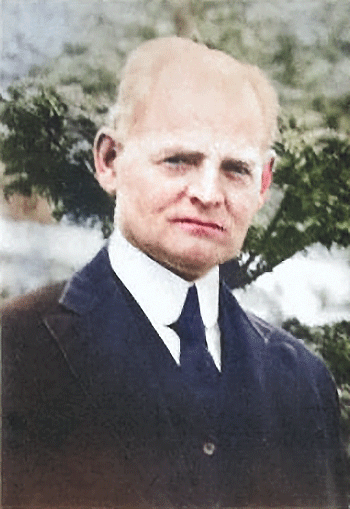
R. A Hardie
The Pyongyang Revival of 1907, also known as the Great Pyongyang Revival, was a pivotal moment in the history of Christianity in Korea. It ignited a spiritual awakening that transformed the religious landscape of the nation and left a lasting legacy on the Korean church. This article explores the history of this remarkable event, exploring its context, key figures, and lasting impact.
Religious Landscape Before the Revival
Before Christianity's arrival, Korean folk religion (Shamanism) and Buddhism were the dominant religious traditions in Korea 1. Confucianism, introduced from China, also held a significant place, particularly among the educated elite 2. Catholicism was first introduced during the late Joseon Dynasty but faced persecution from the authorities 2.
Protestantism arrived later, with the first Protestant church, Sorae Church, established by Seo Sang-ryun on May 16, 1883 2. By the early 20th century, Christianity was still relatively new in Korea, with adherents concentrated mainly in urban centres like Pyongyang and Seoul.
Antecedents of the Revival
The Pyongyang Revival was not an isolated incident. It was preceded by local revivals in Korea, including those in Seoul and Wonsan in 1903 3. These earlier revivals, sparked by factors like famine and social unrest 3, created fertile ground for a spiritual awakening. News of revivals in Wales (1904-1905) and India (1905-1906) reached Korean Christians, inspiring them to seek a similar outpouring of the Holy Spirit 3.
In Pyongyang, a significant antecedent to the 1907 revival was a week of prayer and Bible study held by missionaries in August 1906 4. This gathering, led by Dr. R. A. Hardie, who had been instrumental in the Wonsan Revival of 1903, focused on seeking God's blessing on the Korean church.
Adding to this momentum, in 1903, a regular prayer meeting was held by women missionaries in Wonsan 5. One of these women was M.C. White, who had served in China. This prayer meeting contributed to the spiritual fervor that culminated in the Pyongyang Revival.
The Russo-Japanese War of 1904-1905, fought across Korea, also played a role in setting the stage for the revival 6. The war ended with Korea becoming a colony of the Empire of Japan, a traumatic event for a nation with a long history of independence. This national crisis created a sense of urgency and a longing for spiritual solace among the Korean people.
The Revival Begins
The Pyongyang Revival began in January 1907 during a two-week Bible conference held at the Presbyterian seminary in Pyongyang 3. This conference, attended by approximately 1,500 Korean men, became the epicentre of a spiritual earthquake. Kil Sun-joo, one of the first Korean Protestants ordained as a Presbyterian minister, played a key role in igniting the revival 3. Through his dynamic preaching and heartfelt confession of sins, he sparked a wave of public repentance that swept through the conference 3.
The revival quickly spread beyond the seminary, with a series of revival meetings held in Pyongyang and nearby cities 3. These meetings were characterized by intense prayer, public confession of sin, and a profound sense of God's presence.
Prayers and Practices
The Pyongyang Revival was marked by certain prayers and practices that contributed to its impact. These included:
- Public confession of sin: This practice, modeled by Kil Sun-joo and other leaders, created an atmosphere of humility and brokenness before God 3. During the Bible conference, Kil Sun-joo confessed his own sins, leading others to follow suit 3. This public acknowledgment of wrongdoing fostered a sense of shared responsibility and a desire for genuine repentance.
- Intense prayer: Prayer meetings were a hallmark of the revival, with participants often praying aloud together for hours 7. One missionary described the atmosphere during these prayer meetings: "t" 8.
- Early morning prayer: This practice, which continues to this day in many Korean churches, became a symbol of the revival's emphasis on spiritual discipline 7. The revival instilled a commitment to early morning prayer meetings, with thousands gathering in one place for prayer each morning 7.
- Simultaneous prayer: As the revival spread, the practice of praying aloud together, with many voices rising in unison, became a distinctive feature of Korean church life 7. This practice reflected the unity and collective fervor that characterized the revival.
Personal Testimonies
Numerous personal testimonies emerged from the Pyongyang Revival, providing glimpses into the transformative power of the event. One missionary described the sound of prayer during the revival as "an ocean of prayer beating against God's throne" 9. Another account tells of "strong men . . . pleading for forgiveness and confessing their sins in great agony of spirit" 8. These testimonies highlight the deep sense of conviction and repentance that characterized the revival.
One participant shared, "Our entire community and the Korean church especially last night and today has received such 8.
Lasting Results
The Pyongyang Revival had both immediate and lasting results. In the short term, it led to a significant increase in the number of Protestant converts in Korea. By March 1907, 2,000 people had been converted, and by July of that year, the number had risen to 30,000 10. The revival also sparked the establishment of new churches and Christian institutions, particularly in Pyongyang, which became known as the "Jerusalem of the East" 7.
The revival also had a profound impact on societal issues. It sparked movements against alcohol and smoking, as believers, convicted by the Holy Spirit, sought to transform their lives and communities 11.
The long-term effects of the revival were equally profound. It shaped the spiritual DNA of the Korean church, emphasizing prayer, Bible study, and personal evangelism. The revival also contributed to the growth of Korean nationalism, as Christian leaders played a prominent role in the resistance against Japanese rule 12. By the late 1940s, some 3,000 churches were operating in Korea, a testament to the revival's enduring impact 12.
The revival also fostered a new emphasis on education, as many converts sought to learn more about their faith 13. This led to the establishment of numerous schools and universities, which provided a platform for the spread of Christian ideas and values.
Furthermore, the revival had a significant impact on Korean Protestant spirituality. It introduced key aspects such as early morning prayer and all-night prayer, practices that continue to shape Korean Christian life today 3.
The revival also played a crucial role in fostering a sense of unity and community among the Korean people 13. New converts sought to build strong relationships with their neighbors and create a sense of shared identity, contributing to a stronger social fabric.
Another lasting result of the revival was the emergence of a new generation of Christian leaders who sought social and political reform 13. These leaders, inspired by the revival's message of transformation, played a key role in shaping Korea's path toward modernization and independence.
The Million Movement, an evangelistic effort aimed at winning one million souls for Christ, emerged from the revival's fervor 9. This movement exemplified the revival's emphasis on outreach and evangelism, further contributing to the growth of the Korean church.
A key practice that emerged from the revival was the disciplining of new converts for 6 to 24 months before baptism 14. This practice ensured that new believers were grounded in their faith and prepared for church membership, contributing to the long-term stability and growth of the Korean church.
The Pyongyang Revival played a crucial role in the subsequent growth of Christianity in South Korea 12. Many Christians who experienced the revival in the north later fled to the south during the Korean War, bringing with them their faith and the spiritual legacy of the revival. This contributed to the flourishing of Christianity in South Korea, where it remains a major religious force today.
The revival served as a catalyst for social and political change in Korea 12. It empowered individuals and communities, fostering a sense of agency and responsibility that extended beyond the religious sphere. This contributed to the growth of social movements and the struggle for national independence.
The Pyongyang Revival profoundly shaped Korean Christian identity and practice 3. It instilled a deep commitment to prayer, Bible study, and evangelism, while also fostering unique expressions of spirituality, such as early morning prayer and simultaneous prayer. These practices continue to distinguish Korean Christianity today.
Relationship to Other Revivals
The Pyongyang Revival was part of a larger wave of religious awakenings that swept across the globe in the late 19th and early 20th centuries. It shared similarities with revivals in Wales and India, particularly in its emphasis on prayer and confession of sin 3. The revival also had connections to the Holiness movement, which emphasized personal sanctification and spiritual experience 17.
Scholarly Perspectives
Scholars have examined the Pyongyang Revival from various angles. Some have highlighted its theological significance, emphasizing its impact on Korean Protestant spirituality 18. Others have explored its social and political implications, noting its contribution to Korean nationalism and social reform 19.
Scholars also point to the revival's role in promoting citizen awareness and social engagement 19. The revival challenged individuals to move beyond self-centeredness and become active participants in their communities, contributing to a more just and equitable society.
Some observers have criticized the revival for its Pentecostal characteristics and syncretistic overtones, suggesting that it incorporated elements from Korean shamanist religion 16. These critiques highlight the complexities of interpreting the revival and its relationship to Korean culture and religious traditions.
The revival's impact on the growth of the Korean church in the decades that followed has also been a subject of scholarly inquiry 14. Researchers have explored how the revival's emphasis on prayer, Bible study, and evangelism contributed to the remarkable expansion of Christianity in Korea.
Timeline of Events
| Date | Event | Citation |
| 1883 | First Protestant church established in Korea | 2 |
| 1903 | Local revivals in Seoul and Wonsan | 3 |
| August 1906 | Week of prayer and Bible study in Pyongyang | 4 |
| January 1907 | Pyongyang Revival begins at Presbyterian seminary | 3 |
| Spring 1907 | Revival spreads to other cities | 3 |
| March 1907 | 2,000 converts reported | 10 |
| July 1907 | 30,000 converts reported | 10 |
| 1910s | Christian leaders become prominent in Korean nationalism | 12 |
| Late 1940s | Approximately 3,000 churches operating in Korea | 12 |
Beneficial Takeaways
The Pyongyang Revival offers several valuable lessons for Christians today:
- The power of prayer: The revival demonstrated the transformative power of united, fervent prayer.
- The importance of confession: Public and private confession of sin played a crucial role in creating an atmosphere of humility and repentance.
- The need for spiritual renewal: The revival highlighted the importance of ongoing spiritual awakening and a deepening relationship with God.
Conclusion
The Pyongyang Revival of 1907 was a watershed moment in the history of Christianity in Korea. It ignited a spiritual fire that transformed individuals, churches, and society. The revival's emphasis on prayer, confession, and spiritual renewal continues to inspire Christians around the world. While the city of Pyongyang is now under a regime that suppresses religious freedom, the legacy of the 1907 revival lives on in the hearts of Korean Christians and serves as a testament to the enduring power of the Gospel.
The revival's impact extended far beyond individual conversions. It sparked social reform movements, fueled Korean nationalism, and contributed to the growth of education and Christian institutions. The revival's emphasis on prayer, confession, and spiritual discipline continues to shape Korean Christian identity and practice today.
The Pyongyang Revival stands as a powerful reminder of the transformative potential of spiritual awakening and its ability to shape not only individuals but also entire societies.
Works cited
- Religion in Korea - Wikipedia, accessed on December 18, 2024, https://en.wikipedia.org/wiki/Religion_in_Korea
- Christianity in Korea - Wikipedia, accessed on December 18, 2024, https://en.wikipedia.org/wiki/Christianity_in_Korea
- Pyongyang Revival - Wikipedia, accessed on December 18, 2024, https://en.wikipedia.org/wiki/Pyongyang_Revival
- Korean Revivals Wonsan 1903 and Pyongyang 1907 - Korea, accessed on December 18, 2024, https://www.byfaith.co.uk/paul20102.htm
- The Great Revival Movement of 1907 And its Historical Impact on Korean Church - PCA MNA (Archive), accessed on December 18, 2024, https://2019.pcamna.org/wp-content/uploads/sites/4/2021/06/GreatRevival.pdf
- Jerusalem of the East: The American Christians of Pyongyang, 1895-1942 - Providence, accessed on December 18, 2024, https://providencemag.com/2016/07/jerusalem-east-american-christians-pyongyang/
- 1907 Pyongyang Korea - Revival Library, accessed on December 18, 2024, https://revival-library.org/histories/1907-pyongyang-korea/
- Testimonies of the Korean Revival of 1907 - Prevailing Intercessory Prayer, accessed on December 18, 2024, https://www.path2prayer.com/revival-and-the-holy-spirit/the-korean-revival/testimonies-of-the-korean-revival
- Pyongyang Great Revival (1907-1910) - Korea, accessed on December 18, 2024, https://www.byfaith.co.uk/paulbyfaithtvmathewthoughts18.htm
- 1907-1910 Pyongyang Korea Revival - BEAUTIFUL FEET, accessed on December 18, 2024, https://romans1015.com/1907-pyongyang-revival/
- Prayer: The Key to Revival - International Prayer Connect, accessed on December 18, 2024, https://www.ipcprayer.org/en/ipc-connections/item/5328-prayer-the-key-to-revival.html
- The Pyongyang Revival 100 Years Later | CBN News, accessed on December 18, 2024, https://cbn.com/news/world/pyongyang-revival-100-years-later
- The Korean Pentecost (1907) impact on society and culture - XGospel Ministry, accessed on December 18, 2024, https://www.xgospel.net/the-korean-pentecost-1907-impact-on-society-and-culture/
- How the Korean Pentecost Can Guide Revival Today - The Gospel Coalition, accessed on December 18, 2024, https://www.thegospelcoalition.org/reviews/korean-pentecost/
- The Korean Revival - Prevailing Intercessory Prayer, accessed on December 18, 2024, https://www.path2prayer.com/revival-and-the-holy-spirit/the-korean-revival
- The North Korean Revival of 1907 - The Gospel Coalition, accessed on December 18, 2024, https://www.thegospelcoalition.org/blogs/evangelical-history/the-north-korean-revival-of-1907/
- Towards The Renewal Of The Church In Korea: Interaction Between Revival And Protest Theologies - Fuller Studio, accessed on December 18, 2024, https://fullerstudio.fuller.edu/theology/towards-the-renewal-of-the-church-in-korea-interaction-between-revival-and-protest-theologies/
- Young-Hoon Lee – Korean Pentecost: The Great Revival of 1907 - ResearchGate, accessed on December 18, 2024, https://www.researchgate.net/publication/362620238_Young-Hoon_Lee_-_Korean_Pentecost_The_Great_Revival_of_1907
- A SELF-PSYCHOLOGICAL APPROACH TO THE 1907 REVIVAL MOVEMENT IN KOREA - Drew University, accessed on December 18, 2024, https://digitalcollections.drew.edu/UniversityArchives/ThesesAndDissertations/THEO/PhD/2014/Jang/openaccess/JEJang.pdf
R. A Hardie
R. A Hardie